Choosing among China’s leading Aluminium Bifold Doors manufacturers takes more than comparing catalogue photos. Buyers need to assess frame design, hardware, glazing options, production consistency, and after-sales support. A slim showroom sample can look impressive. But real performance depends on fabrication details, installation, and the project’s climate. No shortlist is perfect.
Industry data offers useful context, though it cannot rank individual door makers. The International Aluminium Institute reported global primary aluminium production of about 70.6 million tonnes in 2023, showing the scale of the material supply chain. This is not a doors-market figure. China’s National Bureau of Statistics reported real-estate development investment of RMB 11,091.3 billion in 2023, down 9.6% year over year. That shift makes careful supplier evaluation especially relevant for buyers weighing cost, lead time, and project risk. Still, context matters.
This guide compares ten Chinese manufacturers using practical checks: product range, technical documentation, customization capability, export experience, and evidence of quality control. Readers should confirm specifications directly with each supplier, including panel dimensions, thermal performance, finish options, and warranty terms. A polished brochure is not proof of consistent production. Treat the rankings as a starting point, then verify samples, references, and project requirements before making a decision.
What Aluminium Bifold Doors Are and How They Work
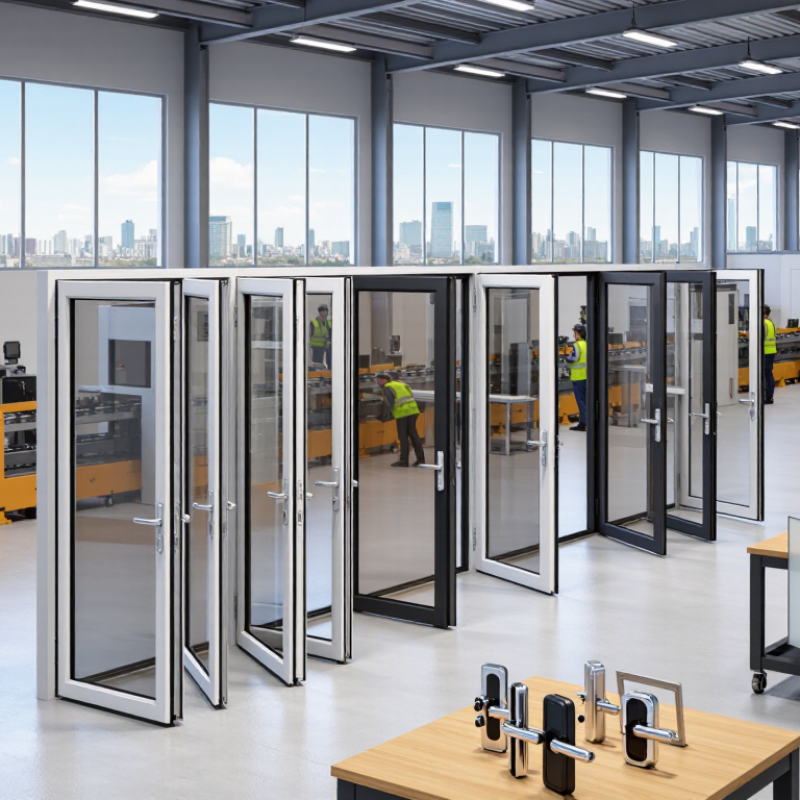
An aluminium bifold door is made of several hinged panels that fold together and slide along a track. When opened, the panels stack at one or both sides, creating a wider passage than a conventional hinged door. A lead panel usually guides the movement, while rollers carry the panels and hinges keep them aligned. The exact hardware varies by design. It sounds simple. In practice, track level, panel weight, and hinge adjustment all affect how smoothly the door operates.
Glazing and seals matter as much as the folding mechanism. The U.S. Department of Energy’s Energy Saver guidance estimates that heat gain and loss through residential windows account for about 25–30% of household heating and cooling energy use. That figure applies to windows, not specifically to bifold doors, but it shows why glass selection deserves attention. The National Fenestration Rating Council provides U-factor and solar heat gain coefficient ratings to help compare products. Lower U-factor generally means less heat transfer; the appropriate solar gain depends on climate and orientation.
Thermal breaks in aluminium frames can reduce heat flow through the metal, while weather seals help limit drafts and rain entry. A poorly aligned bottom track can still cause stiff operation or uneven gaps. Small gaps matter. Before choosing a system, check its panel dimensions, drainage details, glass specification, and tested performance ratings. A broad opening looks impressive, but daily use can expose flaws that a showroom demonstration misses.
How China’s Aluminium Bifold Door Industry Is Structured
China’s aluminium bifold door industry is a chain, not a single factory category. It starts with aluminium smelters and billet suppliers, then moves through extrusion plants that shape frame profiles. Fabricators cut and assemble those profiles, add hinges, rollers, seals, and glazing, and prepare finished systems for domestic projects or export buyers. Some firms handle several stages; others focus on one.
Scale matters, but broad aluminium statistics do not measure bifold doors alone. The International Aluminium Institute reported about 70.6 million tonnes of global primary aluminium production in 2023. China’s National Bureau of Statistics recorded about 41.6 million tonnes of primary aluminium that year. These figures show the depth of the upstream supply base, not door output or quality. That distinction is easy to miss. Downstream performance depends on details such as profile-wall thickness, corner joints, drainage paths, and hardware compatibility. A smooth showroom sample may not reveal how a large door performs after repeated opening or in wind-driven rain.
Production is concentrated in industrial regions with established extrusion, glazing, and hardware suppliers, while distributors and installers connect manufacturers to project markets. Industry reports rarely separate bifold doors from wider window-and-door categories. That is a real data gap. Buyers should therefore compare tested system specifications and factory quality controls, rather than treating national output as proof of product performance.
Criteria for Assessing Chinese Bifold Door Manufacturers
When comparing Chinese aluminium bifold door manufacturers, look beyond polished catalogue photos. Request the full system specification, including aluminium alloy and temper, profile wall thickness, thermal-break design, glazing options, and hardware capacity. A thick-looking frame does not automatically mean a stronger door. That shortcut is tempting, but incomplete.
Ask for test reports that match the exact configuration you plan to buy. Air leakage, water penetration, and wind resistance can change with panel size, glass, seals, and installation details. Small details matter. Check how the panels fold, whether the track drains effectively, and whether replacement rollers and seals are available. A sample should be operated repeatedly, not just admired in a showroom.
Review the manufacturer’s quality checks and communication before placing an order. Ask how staff inspect dimensions, corner joints, surface finish, and packaging, and request dated photos or inspection records from production. This part is easy to overlook. Confirm lead times, spare-parts support, installation guidance, and experience with projects in a similar climate. References can help, though they may not reveal every production problem. No checklist removes all risk; clear specifications and written commitments make comparisons more dependable.
Profiles of 10 Chinese Aluminium Bifold Door Manufacturers
China’s aluminium bifold door manufacturers differ more in production focus than appearance. One profile specializes in standard residential systems. Another offers custom frame sizes for renovations. A third focuses on thermal-break profiles for temperature control. A fourth emphasizes narrow sightlines and larger glass panels. A fifth supplies hardware options for frequent daily use. A sixth handles mixed aluminium and glazing orders. A seventh supports project-based fabrication. An eighth provides varied finishes, from matte black to textured grey. A ninth focuses on compact folding configurations. A tenth serves buyers seeking flexible, smaller production runs. These are useful comparison profiles, not a verified ranking; actual capabilities vary by factory.
Tips: Ask for section drawings, hardware specifications, and recent production photos. Confirm the quoted configuration matches the sample.
A polished catalogue is not proof of consistent quality. Check how the supplier documents measurements, finish tolerances, and packaging before comparing prices. Ask how adjustments are handled if panels do not align on site. Details matter. Some suppliers may communicate slowly, and that is worth weighing alongside product quality. A careful buyer should compare the complete system, not just the aluminium frame.
China Top 10 Aluminium Bifold Doors Manufacturers? - Profiles of 10 Chinese Aluminium Bifold Door Manufacturers
Anonymous comparison table. Manufacturer-specific details were not supplied, so unverified company data is marked accordingly.
| Profile |
Location / Factory |
Bifold Door Product Range |
Technical Details to Verify |
Evidence Needed Before Purchase |
| Manufacturer 1 |
Not provided |
Not independently verified |
Frame system, panel limits, glazing options, and hardware configuration |
Factory address, current product catalogue, and project references |
| Manufacturer 2 |
Not provided |
Not independently verified |
Aluminium alloy and temper, profile dimensions, and thermal-break design |
Material specifications and profile cross-section drawings |
| Manufacturer 3 |
Not provided |
Not independently verified |
Maximum tested door size, panel weight, and opening configuration |
System-specific technical manual and test reports |
| Manufacturer 4 |
Not provided |
Not independently verified |
Glazing thickness, safety-glass options, and approved glass build-ups |
Glazing specifications and applicable safety-glass documentation |
| Manufacturer 5 |
Not provided |
Not independently verified |
Air permeability, water tightness, and wind-load performance |
Test reports for the same door system and configuration being quoted |
| Manufacturer 6 |
Not provided |
Not independently verified |
Thermal and acoustic performance for the specified frame and glazing |
Declared ratings or laboratory reports for the complete door assembly |
| Manufacturer 7 |
Not provided |
Not independently verified |
Coating type, colour options, and finish durability |
Finish specifications, sample approval, and relevant coating test evidence |
| Manufacturer 8 |
Not provided |
Not independently verified |
Hinges, rollers, tracks, locking points, and replacement-part availability |
Hardware schedule, warranty terms, and spare-parts policy |
| Manufacturer 9 |
Not provided |
Not independently verified |
Custom sizing, drainage details, installation requirements, and lead time |
Approved shop drawings, installation guide, and written delivery schedule |
| Manufacturer 10 |
Not provided |
Not independently verified |
Export experience, packaging, quality control, and after-sales support |
Export references, inspection records, packaging details, and service terms |
How to Compare Manufacturers, Products, and Export Services
Comparing aluminium bifold door manufacturers requires more than checking frame thickness or a low quotation. Ask for project-specific test reports covering air leakage, water penetration, and structural performance. Confirm that the tested system matches the quoted configuration: panel width, glass weight, hardware, and opening direction can change results. Small detail. Request written warranty terms and spare-parts availability, too.
Energy performance deserves careful attention. The International Energy Agency’s 2023 Global Status Report for Buildings and Construction states that buildings used about 30% of global final energy in 2022 and produced 26% of energy-related emissions. That does not make one door specification right for every climate. Compare declared U-values, glazing options, thermal breaks, and test methods, then check whether the figures apply to the complete door rather than the glass alone. A brochure can look convincing. It is not evidence.
Export service is part of product quality. Ask how the factory protects finished frames and glass during packing, provides installation drawings, and handles damage claims. Request a sample packing list and a realistic production schedule for your order size. Also verify which party arranges transport, insurance, and destination paperwork. I would compare response speed using the same technical questions for every supplier; still, a quick reply cannot replace factory audits or independent inspection. Some details may be missed. That is exactly why clear records matter.
Conclusion
This article introduces Aluminium Bifold Doors, explaining their folding-panel design, how the panels move along a track, and how they can connect indoor and outdoor spaces while making efficient use of openings. It also outlines the structure of China’s aluminium bifold door industry, from manufacturers focused on complete door systems to businesses specializing in profiles, components, or customized production. Readers will find practical criteria for assessing manufacturers, including product design, material and finish options, quality-control processes, customization capabilities, and experience serving export markets.
The article profiles ten Chinese manufacturers as examples of the range of suppliers available, without treating any one company as the right choice for every project. It also explains how to compare products and suppliers by considering specifications, configuration, pricing, communication, packaging, lead times, and after-sales support. Together, these sections offer a clear framework for evaluating options and selecting a manufacturer that fits a project’s requirements and purchasing priorities.