Technical White Paper
Engineering Mastery of Aluminium Frameless & Minimalist Door Systems
An in-depth analysis of structural metallurgy, kinetic hardware mechanisms, energy performance metrics, and weatherproofing design for international architectural buyers.
1. Structural Metallurgy & Minimalist Extrusion Physics
In contemporary architectural design, the demand for frameless and slim-frame aluminium doors requires an unprecedented balance between structural load-bearing capacity and visual minimalism. Traditional wide-frame fenestration relies on thick outer sightlines to withstand wind loads. Conversely, high-performance frameless glass door systems transfer wind load pressures ($P_{wind}$) directly through reinforced 6063-T6 and 6061-T6 structural aluminium alloy extrusions concealed within structural head tracks and recessed floor channels.
At Changsha Wincraft Aluminum Window Tech Co., Ltd., our engineering team utilizes finite element analysis (FEA) to calculate deflection limits under positive and negative wind pressures. Profiles are designed to adhere to international standards such as ASTM B221 and EN 755. By utilizing primary virgin aluminium ingots with precise magnesium-silicon alloy ratios, our concealed door profiles achieve tensile strengths exceeding 205 MPa and yield strengths over 170 MPa, ensuring structural stability for panels reaching heights up to 6.0 meters.
2. Thermal Barrier Architecture & Glazing Physics
Achieving ultra-low overall U-values ($U_w$) in frameless and ultra-slim aluminium doors requires neutralizing the inherent thermal conductivity of metal ($k \approx 160 \text{ W/m}\cdot\text{K}$). We accomplish this through multi-chamber thermal breaks featuring PA66-GF25 (25% fiberglass reinforced polyamide) insulating strips. These thermal barriers separate outer weather-exposed aluminium components from indoor structural frames, dramatically curbing conductive heat transfer.
When paired with double or triple insulated glass units (IGU)—configured with Low-Emissivity (Low-E) soft coatings, warm-edge silicone polymer spacers, and 90%+ pure argon gas fill—our frameless door systems achieve overall thermal transmittance ratings as low as $1.1 \text{ W/m}^2\cdot\text{K}$ ($U$-factor $\approx 0.19 \text{ BTU/h}\cdot\text{ft}^2\cdot^\circ\text{F}$). Solar Heat Gain Coefficients (SHGC) can be customized down to 0.22, drastically lowering HVAC consumption in tropical and desert climates.
3. Concealed Kinetic Hardware & Bearing Mechanics
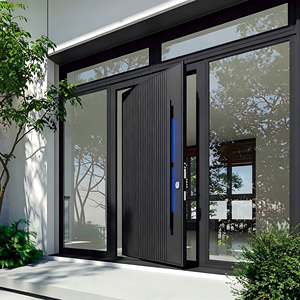
The effortless operation of heavy, oversized glass door leaves relies directly on kinetic bearing mechanics. For oversized entry pivot doors, Wincraft integrates floor-recessed hydraulic pivot spindles crafted from SUS316 stainless steel. These heavy-duty pivot mechanisms are rated to sustain vertical dead loads exceeding 500 kg (1,100 lbs) per leaf while enabling 360-degree rotation with opening resistance below 15 N.
For frameless sliding and multi-slide systems, bottom-rolling track assemblies feature CNC-machined dual-wheel stainless steel bogies with sealed ceramic needle bearings. These precision components distribute structural loads evenly across heavy stainless steel rails, eliminating panel vibration and preventing track wear over tens of thousands of open-close duty cycles.
| System Architecture |
Structural Profile Alloy |
Thermal Transmittance ($U_w$) |
Acoustic Attenuation |
Max Panel Dimensions |
Ideal Application |
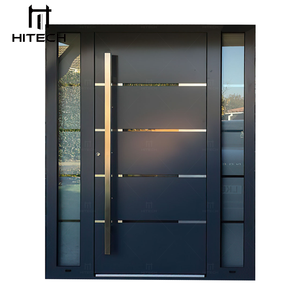
| Slim-Frame Glass Pivot Door |
6063-T6 Anodized / PVDF |
1.3 – 1.6 W/m²K |
35 – 40 dB (STC) |
3000mm (W) × 6000mm (H) |
Grand Entryways, Luxury Villa Facades |
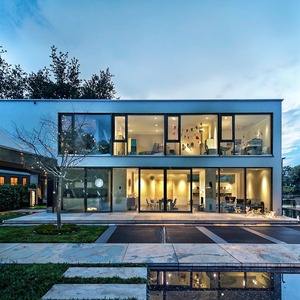
| Frameless Recessed Slide System |
6061-T6 High-Tensile |
1.1 – 1.4 W/m²K |
38 – 42 dB (STC) |
2500mm (W) × 4500mm (H) |
Resort Terraces, Oceanfront Patios |
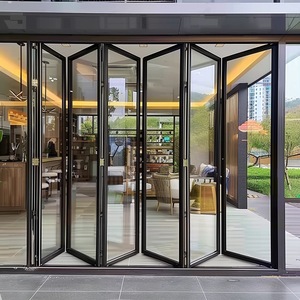
| Thermal Break Accordion Bifold |
6063-T5 Multi-Chamber |
1.2 – 1.5 W/m²K |
36 – 40 dB (STC) |
1200mm (W) × 3500mm (H)/leaf |
Indoor-Outdoor Entertainment Areas |
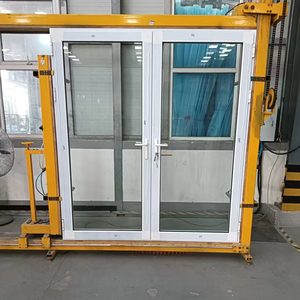
| Heavy-Duty Architectural French Door |
6063-T6 Reinforced |
1.3 – 1.7 W/m²K |
34 – 38 dB (STC) |
1400mm (W) × 3000mm (H)/leaf |
Residential Patios, Commercial Balconies |
4. Surface Treatment & Corrosion Resistance in Coastal Zones
Aluminum doors installed in coastal regions face aggressive atmospheric degradation driven by sodium chloride aerosols and humidity. To prevent filiform corrosion and coating delamination, Wincraft enforces stringent pre-treatment protocols including chromate-free zirconium passivation before powder application.
We offer architectural-grade 70% Fluorocarbon (PVDF) resin finishes and Grade 2 Architectural Anodizing (film thickness $\ge 25 \mu\text{m}$). These surface treatments pass 3,000-hour neutral salt spray tests (ASTM B117) and resist UV degradation under intense solar radiation, retaining color stability and gloss retention for over 25 years without chalking or fading.