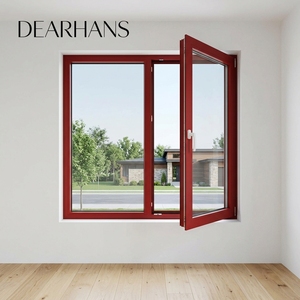
Featured Product Portfolio
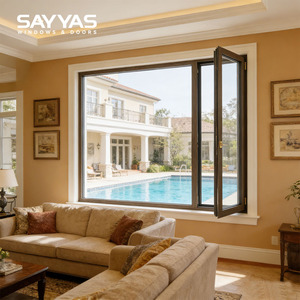
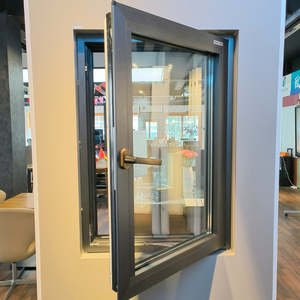
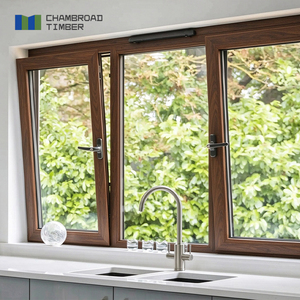
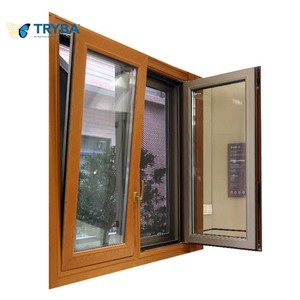
Architectural Aluminium Timber Composite Systems
Factory-direct custom fenestration solutions engineered for extreme thermal insulation, structural integrity, and architectural luxury.
Technical Whitepaper
Material Engineering & Hybrid Composite Architecture
An in-depth structural evaluation of aluminium-timber composite windows for commercial project specifiers, architectural consultants, and luxury residential builders.
1. The Evolution of Hybrid Architectural Fenestration
In high-end architectural engineering, the search for the ultimate envelope material has culminated in the development of Aluminium Timber Composite Windows (often categorized as Alu-Clad Wood or Wood-Aluminium Systems). Historically, building designers faced a tradeoff: solid timber offered unmatched interior warmth, natural elegance, and superior thermal insulation, but demanded labor-intensive exterior maintenance to prevent weathering, UV degradation, and rot. Conversely, standard architectural aluminum provided immense structural strength, slim sightlines, and weather resistance, but suffered from high metallic thermal conductivity.
By combining extruded architectural aluminum profiles with structural, kiln-dried solid timber through decoupled mechanical fast-locking clips, modern China suppliers have engineered a composite system that provides an ideal solution. The exterior aluminum shell shields the building envelope against extreme rain, salt spray, and solar radiation, while the interior timber profile provides natural thermal resistance and high acoustic absorption.
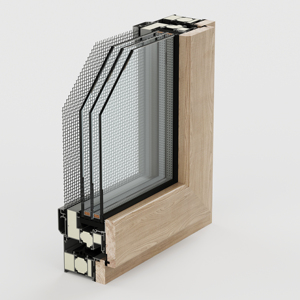
Cross-Sectional Structural Anatomy of Premium Alu-Timber Windows
A high-performance composite window profile relies on four distinct material layers: (1) Outer Rainscreen Shield: High-precision extruded 6063-T6 aluminum alloy treated with PVDF fluorocarbon or architectural powder coating (AAMA 2605 compliant). (2) Differential Motion Connector: Glass-fiber reinforced Polyamide (PA66 GF25) dynamic clips allowing micro-expansion differences ($\Delta \alpha$) between metal and timber without structural distortion. (3) Core Timber Matrix: Laminated, multi-layer finger-jointed timber (Oak, Larch, or Pine) controlled to 8%–12% Equilibrium Moisture Content (EMC). (4) Multi-Chamber Sealing Network: Continuous co-extruded EPDM gaskets providing three-tier airtightness and water pressure equalization.
2. Advanced Thermal Thermodynamics & Sound Insulation
The primary metric evaluating architectural fenestration performance is the overall system heat transfer coefficient, expressed as the $U_w$-Value ($\text{W/m}^2\text{K}$). The mathematical formula determining total energy transfer incorporates frame thermal bridge losses ($U_f$), center-of-glass thermal conduction ($U_g$), and linear perimeter spacer heat loss ($\Psi_g$):
U_w = (A_g · U_g + A_f · U_f + l_g · Ψ_g) / (A_g + A_f)
Leading suppliers in China utilize triple-glazed unit (TGU) assemblies featuring dual Low-Emissivity (Low-E) soft coatings, 95% Argon gas fill, and composite warm-edge spacers (such as Technoform or Swisspacer). When integrated into a multi-chamber thermal break aluminum frame clad with 68mm to 88mm thick solid laminated timber, total system values drop to $U_w \le 0.79 \text{ W/m}^2\text{K}$, comfortably exceeding German Passivhaus Institute (PHI) certification criteria.
Acoustically, timber's cellular micro-structure dampens vibrational kinetic energy. Paired with asymmetrical glass paning (e.g., 6mm outer + 16Ar + 4mm middle + 16Ar + 6.38mm laminated inner), these composite units achieve Sound Transmission Class (STC 42 to STC 48) ratings, dampening urban ambient noise by up to 45 decibels.
3. Wood Species Engineering & Timber Preservation Technologies
The structural reliability of an aluminum timber composite window depends on wood conditioning. Premium China manufacturers utilize automated vacuum-drying kilns to stabilize raw lumber. Finger-jointed laminations eliminate internal natural grain stresses, rendering the timber impervious to twisting, checking, or warping under severe humidity shifts.
- Siberian Larch (Larix sibirica): Exceptionally dense (approx. 590 kg/m³) with high natural resin content, offering inherent fungal decay resistance. Ideal for temperate and cold climate zones.
- European White Oak (Quercus robur): High hardness (Janka rating ~6,000 N) and rich grain aesthetics, preferred for luxury villa developments and historic restoration projects.
- Pinus Sylvestris (Scots Pine): Excellent strength-to-weight ratio and natural thermal insulation coefficient ($\lambda \approx 0.13 \text{ W/mK}$). Treated with water-based organic micro-emulsions for rot resistance.
- Teak (Tectona grandis): Premium hardwood selected for tropical coastal installations requiring maximum resistance to atmospheric humidity and termite activity.
Engineering Advantages
Why Leading Global Specifiers Choose China Suppliers
Discover the manufacturing innovations driving China’s high-performance architectural composite window sector.
Precision CNC Joinery
Utilizing German 5-axis CNC machining centers (0.05mm tolerance) to execute seamless corner dovetail joints and automated hardware recess routing.
Extreme Thermal Decoupling
Polyamide thermal breaks combined with multi-chamber EPDM seals eliminate interior frame condensation even during extreme winter sub-zero drops.
Multi-Point Security Locking
Integrated German hardware suites (Siegenia, Roto, Hoppe) offering RC2 and RC3 burglar resistance standards with heavy-duty anti-pry mushroom cams.
AAMA 2605 Surface Finishes
Exterior powder coatings and PVDF fluorocarbon finishes withstand 4,000+ hours of continuous salt-spray testing without chalking or fading.
Eco-Certified Timber Sourcing
100% FSC and PEFC certified sustainable forestry timber, processed with eco-friendly European water-based protective stains (Sikkens/Zobel).
Full OEM/ODM Engineering
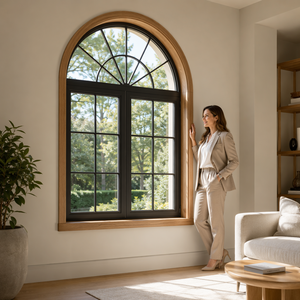
BIM/CAD shop drawing production within 24 hours, custom extrusions, custom arching, fanlights, and fully concealed sash configurations.
Industry Market Intelligence
Global Procurement Trends in Architectural Composite Windows (2025–2030)
Key technological shifts shaping the sourcing strategies of international contractors, real estate developers, and window importers.
1. The Shift Toward Carbon Neutrality & EPD Certification
As global building regulations (such as the EU Energy Performance of Buildings Directive and US Title 24) tighten embodied carbon limits, procurement directors are scrutinizing the supply chain. Timber acts as a natural carbon sink, storing approximately 1 ton of $CO_2$ per cubic meter of wood. When paired with recycled low-carbon aluminum extrusions melted via hydroelectric power, Chinese composite window suppliers are issuing verified Environmental Product Declarations (EPD), empowering buyers to qualify for LEED Gold and BREEAM Outstanding project accreditations.
2. Ultra-Slim Sightlines & Concealed Hardware Engineering
Modern architectural trends favor maximalist glass ratios with minimalist frame visibility. Next-generation composite windows incorporate concealed hinges, recessed drain channels, and flush sash profiles. By hiding the sash frame behind the exterior aluminum rainscreen, architects achieve an unbroken glass façade aesthetic while maintaining the structural stability and warm interior wood finish required for residential comfort.
3. Smart Building Integration & Motorized Actuation
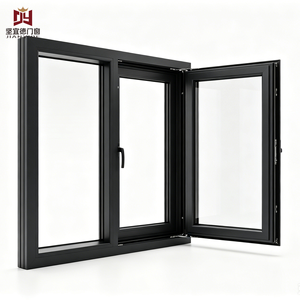
Commercial and residential automation trends are driving the integration of motorized chain actuators concealed within the window profile. In response, premier China factories now offer composite windows pre-wired for Smart Home Control Systems (KNX, Zigbee, BacNet). Integrated magnetic contacts monitor window opening status, while automated weather sensors automatically close tilt-and-turn windows during sudden precipitation or elevated wind velocity.
4. Direct OEM/ODM Supply Chain Optimization
Historically, Western developers sourced composite windows through local brand resellers at high markups. Today’s globalized supply chain enables direct procurement from tier-1 Chinese manufacturers. By leveraging digital engineering collaboration tools (REVIT, AutoCAD), clients receive custom shop drawings, rapid physical corner samples, and factory-direct container shipments—reducing total fenestration procurement budgets by 35% to 50% without sacrificing technical specifications.
Specification Benchmark
B2B Technical Performance Matrix
Compare standard composite window configurations against international building code benchmarks.
| Performance Parameter | Standard Double Glazed Composite | Passive House Triple Glazed | Anti-Hurricane / Extreme Load | Testing Standard Compliance |
|---|---|---|---|---|
| Thermal Transmittance ($U_w$) | 1.2 - 1.4 W/m²K | 0.75 - 0.85 W/m²K | 1.1 - 1.3 W/m²K | EN ISO 10077-2 / NFRC 100 |
| Acoustic Insulation ($R_w$) | STC 35 - 38 dB | STC 42 - 45 dB | STC 45 - 50 dB (Laminated) | EN ISO 140-3 / ASTM E90 |
| Wind Load Resistance | Class 4 (approx. 2.5 kPa) | Class 5 (approx. 3.0 kPa) | Class E5400 (5.4 kPa / Florida TAS) | EN 12210 / ASTM E330 |
| Water Tightness | Class 9A (600 Pa) | Class E1050 (1050 Pa) | Class E1200 (1200 Pa) | EN 12208 / ASTM E547 |
| Air Permeability | Class 4 (0.5 m³/h.m) | Class 4 (0.1 m³/h.m) | Class 4 (High Pressure Airtight) | EN 12207 / ASTM E283 |
| Glazing Specification | 6mm Low-E + 16Ar + 6mm Clear | 5mm Low-E + 14Ar + 5mm + 14Ar + 5mm Low-E | 6mm Low-E + 12Ar + 6mm + 1.52PVB + 6mm Extra Clear | IGCC / EN 1279 Certified |
| Timber Profile Thickness | 68 mm Laminated Wood | 78 mm / 88 mm Laminated Wood | 78 mm Dense Oak / Teak Core | DIN 68121 Standard |
Why Partner With Us
Factory Direct Capabilities & OEM Expertise
Changsha Wincraft Aluminum Window Tech Co., Ltd. delivers end-to-end engineered fenestration solutions for global importers, architects, and building contractors.
20,000 m² Advanced Production Hub
Equipped with automated aluminum extrusion cutting, high-speed timber milling lines, robotic glass sealing units, and digital assembly bays operating under ISO 9001 standards.
24-Hour Design & Shop Drawing Turnaround
Our dedicated engineering desk reviews architectural elevation plans, structural wind load requirements, and energy goals, delivering accurate CAD renderings and BIM models within one business day.
4-Week Standard Production Lead Time
Streamlined material logistics and modular assembly processes ensure standard custom orders are ready for export shipping within ~4 weeks, backed by batch delivery scheduling for multi-phase projects.
Full Export Logistics & Packing Protection
Products are packed with protective film, corner foam guards, water-resistant shrink wrapping, and fully enclosed fumigated plywood crates designed for ocean freight and container unloading safety.
Global Certification Compliance
Products engineered to meet international building performance regulations, including European CE (EN 14351-1), Australian AS2047, and North American NFRC / AAMA certifications.
Dedicated OEM / ODM Private Labeling
Supporting wholesale distributors with custom profile extrusions, proprietary hardware branding, customized packaging, and long-term exclusive market supply agreements.
Frequently Asked Questions
B2B Buyer Technical & Sourcing FAQ
Essential guidance for international buyers purchasing aluminum timber composite windows from China.
Do you accept OEM and ODM orders for custom aluminum timber composite windows?
Yes, fully. We specialize in OEM and ODM cooperation for global window distributors, architectural contractors, and brand owners. We can manufacture custom profiles according to your exact CAD/DWG drawings, provide custom wood species, apply custom powder coating colors (RAL palette), offer private-label packaging, and develop proprietary window hardware systems tailored to your market.
How do aluminum clad wood windows prevent moisture rot and thermal expansion stress?
Our composite windows use dynamic, snap-on nylon (PA66 GF25) dynamic clips rather than direct rigid gluing between the wood and aluminum. This creates a continuous 3mm to 5mm ventilation cavity between the aluminum exterior shell and the inner timber frame. Any condensed vapor drains harmlessly via bottom weep holes, while the independent dynamic clips absorb differential thermal expansion ($\Delta \alpha$) without warping the wood or popping glass seals.
What is your standard production lead time for export orders?
Standard customized orders require approximately 4 weeks for manufacturing once shop drawings and material specifications are formally approved. For large multi-unit commercial or residential real estate projects, we coordinate staggered batch production and shipping schedules matched to your jobsite installation timeline.
Can you provide engineering design proposals and CAD/BIM drawings prior to deposit?
Yes. Our dedicated engineering team collaborates directly with project architects, quantity surveyors, and buyers. Upon receipt of your architectural drawings or rough dimension schedules, we generate design proposals, thermal calculations, and 24-hour preliminary shop drawings for review.
How do you protect wood finishes during international ocean transport?
All solid timber profiles are treated with multi-layer water-borne elastomeric coatings (such as German Sikkens) that seal against humidity shifts. Finished units are wrapped in scratch-resistant protective foil, reinforced with corner bumpers, sealed in moisture-proof plastic wrapping, and secured inside heavy-duty, fumigated ISPM-15 compliant plywood crates to guarantee damage-free transit.
Can your window assemblies meet localized building codes in North America, Australia, or the EU?
Yes. Share your local wind load criteria (Pascals), thermal energy standards ($U$-factor / SHGC), and water penetration thresholds with us. We configure glass build-ups (e.g., tempered, laminated Low-E), structural aluminum wall thicknesses, and hardware configurations to meet standards such as AS2047 (Australia), NFRC/AAMA (USA), and CE EN 14351-1 (Europe).
Request an Engineered Quote & Shop Drawing Proposal
Direct factory pricing, comprehensive technical consultations, and 24-hour CAD shop drawing turnarounds for your residential or commercial development.
Contact Us