Featured China Aluminum Alloy Door & Window Systems
Factory-direct fenestration systems manufactured with precision extrusion profiles, thermal breaks, and commercial-grade structural integrity.
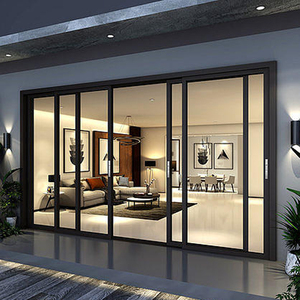
AS2047 Double Glazed Aluminum Stacker Sliding Doors Commercial Exterior Patio Panoramic Sliding Door
Engineered for extreme atmospheric conditions and compliance with Australian AS2047 standards. Features multi-track stacker configurations, double-glazed insulated tempered glass, and low-friction stainless steel rollers.
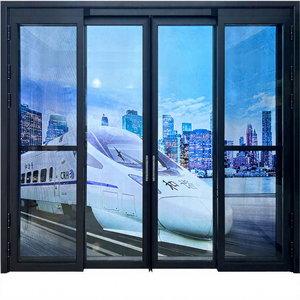
Modern Multi-functional Stacked Double-Glazed Aluminum PT/PD Door (Swing & Slide Dual Action)
Innovative Pivot-Tilt / Sliding-Swing mechanism offering versatile spatial control. Combines modern architectural space-saving concepts with thermal insulation and heavy-duty concealed hinges.
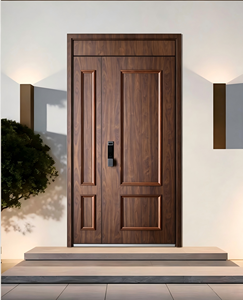
Aluminum Carved Entry Door Wood Grain Finish CNC Pattern Anti-Theft Waterproof Villa Door
High-security luxury entrance solution crafted with high-precision CNC aluminum carving, fluorocarbon heat-transfer wood grain finish, and anti-tamper multi-point lock systems.
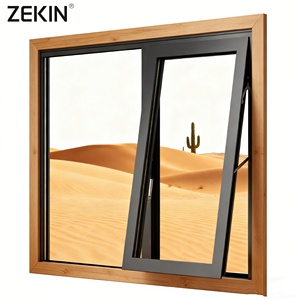
ZEKIN American Style Outward Opening Awning Window Hurricane Impact Double Glass Window
Certified under NFRC and AS2047 protocols for severe weather endurance. Features hurricane-resistant laminated safety glass, pressure-equalized drainage, and high design pressure (DP) resistance.
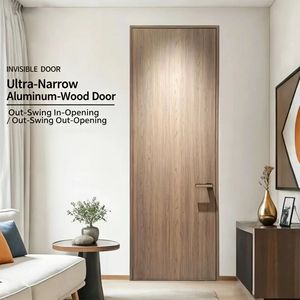
Soundproof and Moisture-Resistant Aluminum-Wood Composite Door with Outward-Flat Design
Hybrid structural architecture uniting external weather-resistant 6063-T5 aluminum profiles with internal hardwood warmth. Delivers an acoustic attenuation up to 42 dB.

Heavy-Duty Commercial Aluminum Swing Doors with High Traffic Resistance
Designed for retail entrances, public buildings, and corporate plazas. Features reinforced corner keys, heavy-duty floor springs or overhead hydraulic closers, and high-security deadbolts.
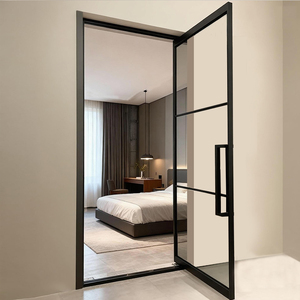
Apartment Building & Office Partition Glass Swing Door Slim Frame Pivot Hinge Door
Architectural narrow-frame aluminum casement and pivot doors for high-end residential interiors and corporate workplace partition systems. Features narrow sightlines and acoustic perimeter seals.
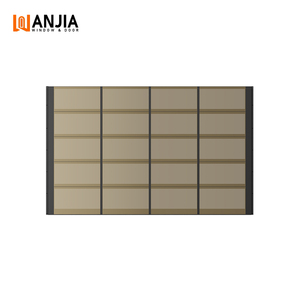
Classical Electric Powered Aluminum Sectional Garage Door with Tempered Black Glass
Modern automotive enclosure featuring anodized aluminum frame tracks, high-impact black tempered glass panels, quiet ceiling-mounted motor operators, and smart infrared safety sensors.
1. Industrial Metallurgical Standards & Fabrication Blueprint
Evaluating China aluminum alloy door manufacturers requires a deep technical understanding of profile chemistry, extrusion tolerances, and thermal barrier engineering. China accounts for over 55% of global primary aluminum extrusion output, with specialized manufacturing hubs centered in Hunan, Guangdong, and Shandong provinces. For international architects, procurement directors, and commercial real estate developers, selecting the correct metallurgical grade and structural design dictates long-term performance, wind load deflection resistance, and code compliance.
1.1 Structural Aluminum Alloys: 6063-T5 vs. 6061-T6 Engineering Parameters
The backbone of architectural fenestration relies on wrought aluminum-magnesium-silicon alloys. The standard grade specified across premium Chinese door factories is 6063-T5 aluminum, prized for its exceptional surface finish post-extrusion, complex multi-cavity design capability, and high resistance to atmospheric corrosion. For heavy-duty curtain walls, high-rise structural entryways, or hurricane-rated sliding systems, manufacturers utilize 6061-T6 aluminum, which provides higher ultimate tensile strength ($290 \text{ MPa}$ vs. $185 \text{ MPa}$) and yield strength ($240 \text{ MPa}$ vs. $145 \text{ MPa}$).
| Mechanical & Physical Property | Aluminum Alloy 6063-T5 | Aluminum Alloy 6061-T6 | Engineering Significance in Door Systems |
|---|---|---|---|
| Ultimate Tensile Strength | $\ge 185 \text{ MPa}$ | $\ge 290 \text{ MPa}$ | Determines resistance to structural catastrophic failure under extreme wind loads. |
| Yield Strength (0.2%) | $\ge 145 \text{ MPa}$ | $\ge 240 \text{ MPa}$ | Defines the threshold where profile bending becomes permanent/irreversible. |
| Elongation at Break | $\ge 8\%$ | $\ge 10\%$ | Measures ductility; critical for complex corner Crimping & CNC milling operations. |
| Wall Thickness Standard | $1.4\text{mm} - 2.0\text{mm}$ (Residential) $2.0\text{mm} - 3.0\text{mm}$ (Commercial) |
$2.5\text{mm} - 4.5\text{mm}$ (Structural/Curtain) | Ensures frame deflection does not rupture double/triple glazed sealants. |
| Primary Application | Sliding Doors, PT Doors, Villa Entryways | High-Rise Commercial Swing Doors, Glass Louvers | Balance between aesthetic surface smoothness and mechanical load capability. |
1.2 Thermal Break Technology: Polyamide (PA66 GF25) Barrier Science
Aluminum has a high thermal conductivity ($k \approx 200 \text{ W/m}\cdot\text{K}$), which presents an energy loss risk if left unmitigated. Top China suppliers overcome this physical limitation by employing advanced Iso-Baric Thermal Break Technology. This involves inserting structural polyamide strips reinforced with 25% glass fiber (PA66 GF25) between the interior and exterior aluminum profiles.
PA66 GF25 matches the coefficient of thermal expansion of aluminum ($\alpha \approx 2.3 \times 10^{-5} \text{ K}^{-1}$), preventing delamination during severe ambient temperature fluctuations between winter freeze and summer solar heat. Utilizing multi-cavity thermal break designs filled with expanded Polyurethane (PU) or Aerogel insulation allows system U-factors to reach ultra-low values of $U \le 1.1 \text{ W/m}^2\cdot\text{K}$, meeting European Passive House and US ENERGY STAR® standards.
1.3 Advanced Surface Treatments & Environmental Protection
To maintain aesthetic beauty and operational performance over a 30-year lifecycle in coastal or harsh industrial environments, Chinese manufacturers utilize four core surface treatment processes:
- Fluorocarbon (PVDF) Spray Coating: Polyvinylidene Fluoride coatings applied in 3-coat or 4-coat baking cycles deliver superior UV stability and chalking resistance, meeting AAMA 2605 specification standards. Ideal for high-sun exposure regions like the Middle East and Australia.
- Architectural Anodizing (Class I & II): Electrochemical oxidation forming an integral aluminum oxide layer ($15\mu\text{m} - 25\mu\text{m}$ thickness). Provides exceptional hardness, metallic elegance, and resistance to salt spray corrosion (ASTM B117 testing exceeding 3,000 hours).
- Electrostatic Powder Coating: Utilizing Qualicoat-certified thermosetting powders (Qualicoat Class 2 or 3) available in standard RAL palette choices. Environmentally clean with zero volatile organic compounds (VOCs).
- 3D & 4D Wood Grain Thermal Transfer: Combines protective base coats with high-temperature vacuum heat-transfer films to replicate natural teak, oak, or walnut textures with superior weatherability compared to organic timber.
Corporate Manufacturing Strengths & Global Footprint
Changsha Wincraft Aluminum Window Tech Co., Ltd. leads the export industry with vertical integration, advanced CNC machining, and rigorous quality assurance.
Complete OEM & ODM Fabrication
Full-spectrum private labeling, custom profile extrusion matrix development, custom packaging, and hardware integration aligned directly with project blueprints.
Rigorous QA/QC Testing Protocol
In-house laboratory verification including air-tightness testing (ASTM E283), water penetration resistance under static pressure (ASTM E331), and structural load capacity (ASTM E330).
Global Logistics & DDP Services
Fumigated non-wood crating, steel-band reinforced export packaging, sea freight containerization, and seamless customs documentation handling worldwide.
2. Global Sourcing Trends in Aluminum Fenestration (2025–2030)
The international architecture market is undergoing a seismic shift driven by strict decarbonization targets, rising energy costs, and a demand for seamlessly integrated living spaces. Procurement managers sourcing from China aluminum door suppliers must adapt to three macro trends defining the next decade of fenestration engineering:
2.1 Ultra-Slim Sightlines & Panoramic Glazing Engineering
Minimalist architectural design demands maximum visible glass area with hidden frames. Modern Chinese manufacturers are pioneering ultra-slim sliding door profiles with vertical interlock stiles measuring as narrow as 18mm to 25mm. Achieving structural stability with such slim profiles requires embedding high-tensile carbon-fiber reinforcement bars inside the aluminum extrusion chambers and utilizing structural silicone glazing (SSG) to transfer wind loads directly into double- or triple-pane tempered glass units.
2.2 Low-Carbon Aluminum & Circular Manufacturing
With the implementation of the European Union's Carbon Border Adjustment Mechanism (CBAM) and global ESG reporting requirements, the embodied carbon of aluminum doors is under intense scrutiny. Leading suppliers in China are transitioning to Green Aluminum billets smelted using hydroelectricity rather than coal-fired power, alongside incorporating up to 30% recycled post-consumer aluminum scrap. This transition reduces profile embodied carbon from $16 \text{ kg CO}_2/\text{kg Al}$ down to less than $4 \text{ kg CO}_2/\text{kg Al}$.
2.3 Smart Hardware, Motorization & Mechatronic Integration
Door systems are evolving into active building envelope elements. Modern aluminum stacker sliding doors and sectional garage doors now incorporate concealed drive motors, multi-point electronic locking systems, dynamic glass tinting (electrochromic glass), and automatic weather-sensing closing mechanisms compatible with major Smart Home protocols (Matter, Zigbee, KNX).
Information Gain: Key Quality Audit Checklist for B2B Buyers
When evaluating mill-test certificates (MTC) and factory audits from China aluminum alloy door suppliers, always verify:
- Alloy Chemical Composition: Confirm Magnesium ($0.45\% - 0.9\%$) and Silicon ($0.2\% - 0.6\%$) balance under GB/T 5237.1 standards.
- Corner Joint Fabrication: Ensure corners use mechanical crimping cleats with injected two-component epoxy glue rather than bare screw connections to prevent corner water leaks.
- EPDM Gasket Quality: Specify peroxide-cured EPDM weatherstripping gaskets rather than cheap PVC gaskets to prevent shrinking, stiffening, and air infiltration failure over time.
- Glass Unit Certification: Verify double-glazed IGUs feature dual-seal perimeter construction (Primary butyl seal + Secondary structural silicone) certified under SGCC, IGCC, or EN 1279.
Frequently Asked Questions (Sourcing & Procurement FAQ)
Clear answers to vital engineering, logistical, and customization questions for international B2B purchasers.
Q Do you accept full OEM and ODM orders for custom architectural aluminum doors?
Yes, full OEM and ODM cooperation is a core business strength of Changsha Wincraft. We support private labeling, custom profile dye extrusion development based on client CAD/BIM drawings, custom powder coating color matching (RAL/NCS), branded packaging, and hardware integration matching regional market preferences.
Q What is the standard production lead time for customized export orders?
Standard customized orders are typically manufactured within 4 weeks (approximately 25 to 30 calendar days) after final shop drawing approval and deposit confirmation. For large multi-unit residential or commercial project orders, production is scheduled in optimized batches matching your construction site installation sequence.
Q Can your engineering team provide shop drawings and structural calculations before production?
Absolutely. Our dedicated engineering department works directly with architects, general contractors, and developers. We deliver initial 2D/3D design renderings and technical proposals within 24 hours, followed by comprehensive CAD shop drawings detailing profile cross-sections, anchorage details, and glass build-ups for sign-off prior to extrusion cutting.
Q How do you ensure safe international sea freight shipping for large glass door units?
All products undergo heavy-duty export packaging protocols. Frames are wrapped in protective polyethylene foam films and corner guards. Complete assemblies or knocked-down (KD) kits are packed into fully enclosed, fumigation-free plywood crates reinforced with internal steel banding and shock-absorbing foam spacers to withstand ocean freight movements.
Q Can your aluminum door and window systems meet regional building codes in my country?
Yes. We engineer door systems specifically tailored to destination building codes including North American NFRC/AAMA ratings, Australian AS2047/AS1288 standards, European CE mark (EN 14351-1), and UK Building Regulations (Part L & Part Q). Share your local wind pressure, acoustic requirement, and thermal performance targets with our team to configure compliance.
Q What warranties apply to your factory-direct aluminum alloy door systems?
We provide a 10-year structural warranty on extruded aluminum alloy profiles, a 10-to-15-year warranty on PVDF and anodized surface finishes against peeling or fading, a 5-year warranty on insulated glass units against seal failure/fogging, and a 3-to-5-year warranty on architectural operational hardware.
Start Your Sourcing Consultation with Our Engineering Team
Send us your project drawings, architectural schedules, or OEM specifications. Receive a comprehensive technical proposal, design renderings, and factory-direct quotation within 24 hours.