Architectural Engineering Whitepaper: Advanced Aluminium Glass Door Systems in Modern Fenestration
In contemporary commercial and high-end residential architecture, the envelope of the building serves as the critical intersection between aesthetic vision, structural performance, and thermodynamic efficiency. As a recognized global benchmark in architectural glazing, Changsha Wincraft Aluminum Window Tech Co., Ltd. produces structural fenestration systems tailored to strict physical and environmental loads. Selecting the ideal aluminium glass door manufacturer and supplier requires a thorough analysis of metallurgical composition, thermal bridge mitigation, structural wind-load calculation, structural silicone integration, and verified cycle testing.
This whitepaper delves into the physics, manufacturing standards, market evolution, and procurement frameworks necessary for architects, real estate developers, structural consultants, and facade contractors to make fully informed sourcing decisions.
1. Enterprise Authority & Precision Manufacturing Infrastructure
Changsha Wincraft Aluminum Window Tech Co., Ltd. operates an integrated research, extrusion processing, and fenestration fabrication infrastructure spanning over 20,000 square meters. Unlike assembly-only workshops, Wincraft maintains complete chain ownership over profile milling, thermal break strip insertion, corner crimping torque control, double/triple insulated glass unit (IGU) assembly, and dynamic weather testing.
Custom OEM/ODM Engineering
Full support for OEM private-label production and custom ODM profile design. Our engineering team converts architectural schematics into 3D CAD/BIM shop drawings within 24 hours.
AAMA & CE Compliance
All extrusion alloys (6063-T5 / 6063-T6) and glass assemblies meet international standard parameters for air infiltration (EN 12207 Class 4) and structural wind load (AAMA 101/I.S.2/A440).
4-Week Rapid Execution
Automated multi-axis CNC machining lines ensure a standard 4-week production lead time for custom door packages, backed by batch delivery scheduling for multi-phase projects.
2. Structural Metallurgy & Mechanical Profile Engineering
The primary material foundation of premium aluminium glass doors is high-purity aluminum alloy extrusions. Wincraft standardizes on AA6063-T5 and AA6063-T6 aluminum profiles due to their ideal balance of tensile strength, corrosion resistance, surface finish acceptance, and extrusion precision.
- Structural Wall Thickness: Heavy-duty sliding and bifold doors utilize structural profile wall thicknesses ranging from 1.6mm up to 3.0mm in high-load structural spans, surpassing basic residential minimums to prevent deflection under severe wind loads.
- Polyamide Thermal Barriers (PA66-GF25): To eliminate thermal conduction across the metallic profile, Wincraft integrates 24mm to 34mm structural polyamide strips reinforced with 25% glass fiber (PA66-GF25). This lowers frame U-values ($U_f$) down to $1.3 - 1.8 W/m^2K$, preventing interior condensation in frigid climates and reducing cooling loads in tropical zones.
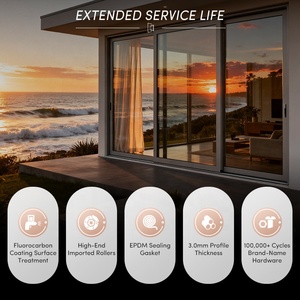
- Qualicoat & Anodizing Surface Finishes: Exterior surfaces undergo electrostatic fluorocarbon (PVDF) coating or Qualicoat-certified powder coating resistant to salt spray corrosion (exceeding 2,000 hours of ASTM B117 salt spray testing), crucial for coastal resort developments.
3. Glazing Technology & Solar Optical Performance
The glass unit constitutes up to 85% of the total door surface area. Achieving high thermodynamic efficiency requires calculated IGUs matched to regional solar heat gain coefficients (SHGC) and overall thermal transmittance (U-Factor).
Wincraft integrates advanced glazing configurations, including double-glazed ($6\text{mm} + 12\text{Ar} + 6\text{mm}$) and triple-glazed ($5\text{mm} + 9\text{Ar} + 5\text{mm} + 9\text{Ar} + 5\text{mm}$) units utilizing soft-coat Low-E (Low-Emissivity) technology. For storm-prone zones such as Florida, the Caribbean, and coastal East Asia, Wincraft manufactures hurricane-impact laminated glass utilizing SentryGlas® (SGP) or high-viscosity PVB interlayers. These hold glass intact even after severe impact, offering high anti-burglary protection and resistance to cyclic wind pressure loads up to ±5,000 Pa.
4. Comparative Engineering Matrix
The following performance matrix illustrates the physical parameters across primary aluminium glass door opening typologies manufactured by Wincraft:
| Door System Typology | Thermal Transmittance ($U_w$) | Acoustic Sound Proofing (STC) | Wind Load Resistance (Pa) | Water Tightness (Pa) | Ideal Application Scenario |
|---|---|---|---|---|---|
| Thermal Break Lift & Slide | 1.1 – 1.4 W/m²K | 38 – 44 dB | 4,500 Pa (Class 5A) | 750 Pa (Class E750) | Luxury Coastal Villas, High-Rise Penthouses |
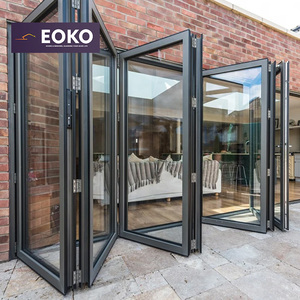
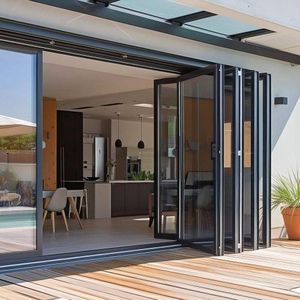
| Heavy Duty Accordion Bifold | 1.3 – 1.7 W/m²K | 35 – 40 dB | 3,500 Pa (Class 4) | 600 Pa (Class E600) | Resort Patios, Restaurants, Wide Openings |
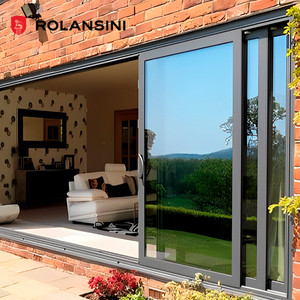
| Minimalist Slim-Line Sliding | 1.4 – 1.8 W/m²K | 34 – 38 dB | 3,000 Pa (Class 4) | 450 Pa (Class 9A) | Modern Architectural Residences |
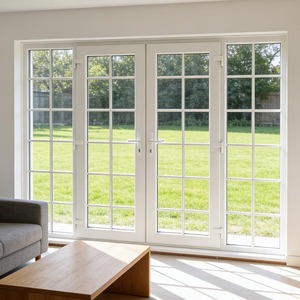
| Hurricane Impact Swing/Pivot | 1.5 – 1.9 W/m²K | 36 – 42 dB | 5,000 Pa (Extreme) | 900 Pa (High Pressure) | Main Entrance Doors, Commercial Façades |
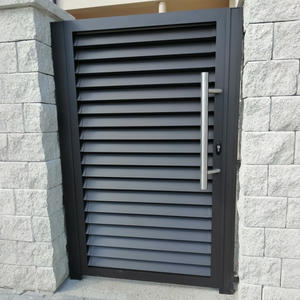
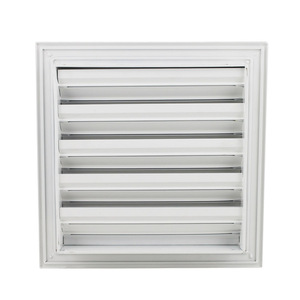
| Architectural Louver Gate/Vent | N/A (Ventilation focus) | 15 – 22 dB | 2,500 Pa (Class 3) | Weather-Louvered Seals | Privacy Gates, Equipment Enclosures |
5. Future Sourcing & Architectural Procurement Trends (2025–2030)
As international energy codes tighten (such as EU NZEB standards and US IECC regulations), the global market for aluminium glass doors is experiencing a massive paradigm shift. Buyers and contractors should align with suppliers who actively invest in the following operational vectors:
Ultra-Narrow Sightlines & Structural Glass Bonding
Architects increasingly demand frame sightlines under 20mm. Achieving this without sacrificing structural integrity requires structural silicone bonding, where the glass IGU acts as a load-bearing stiffener within the aluminium frame.
Low-Carbon Recycled Aluminum (Cradle-to-Cradle)
Decarbonization policies prioritize green aluminum produced using hydroelectric power and high post-consumer recycled metal scrap, reducing embodied carbon by up to 75% compared to primary smelter aluminium.
Motorization & Building Automation (BIM/IoT)
Integration of concealed electromagnetic motorized tracks, smart sensor locks, and automated climate control systems connected via Modbus or KNX protocols for commercial building management systems (BMS).
Modular Prefabricated Assembly Packages
To reduce expensive job-site labor in North America and Europe, Wincraft supplies pre-drilled, knock-down (KD) or semi-assembled units with pre-calibrated hardware tracks, facilitating rapid field installation.
6. Strategic Supplier Audit & QC Verification Checklist
When vetting an overseas aluminium glass door manufacturer, procurement teams must conduct technical audits beyond price-per-square-meter comparisons. Wincraft adheres to a 4-tier quality assurance pipeline:
- Raw Extrusion Verification: Spectrometric chemical analysis of 6063 billets to verify magnesium and silicon ratios, ensuring post-aging T5/T6 hardness reaches 12-14 Webster Hardness units.
- Corner Joinery Mechanical Strength: High-precision German-imported corner crimping machines coupled with dual-component structural corner adhesives to eliminate frame joint opening and water leakage.
- Glazing Seal Integrity: Use of continuous EPDM weather-stripping gaskets (manufactured to DIN 7863 standards) combined with automated secondary sealant robots for dual-seal IGUs.
- Export Container Packaging Protocols: Full perimeter foam wrapping, custom fumigated wooden crates, heat-sealed anti-moisture PE films, and internal container tie-down bracing to guarantee 0% glass breakage during ocean transit.
Request Full Architectural Specifications & Technical Drawings
Connect directly with Wincraft engineering department to receive system catalogs, CAD details, testing certificates, and factory-direct pricing for your project.
Get Catalog